How Every Ornament on This Site Is Drawn in Code
No image files, no icon fonts: a short tour of the yantra, the gilt frames and the emblems, and the few lines of geometry behind them.
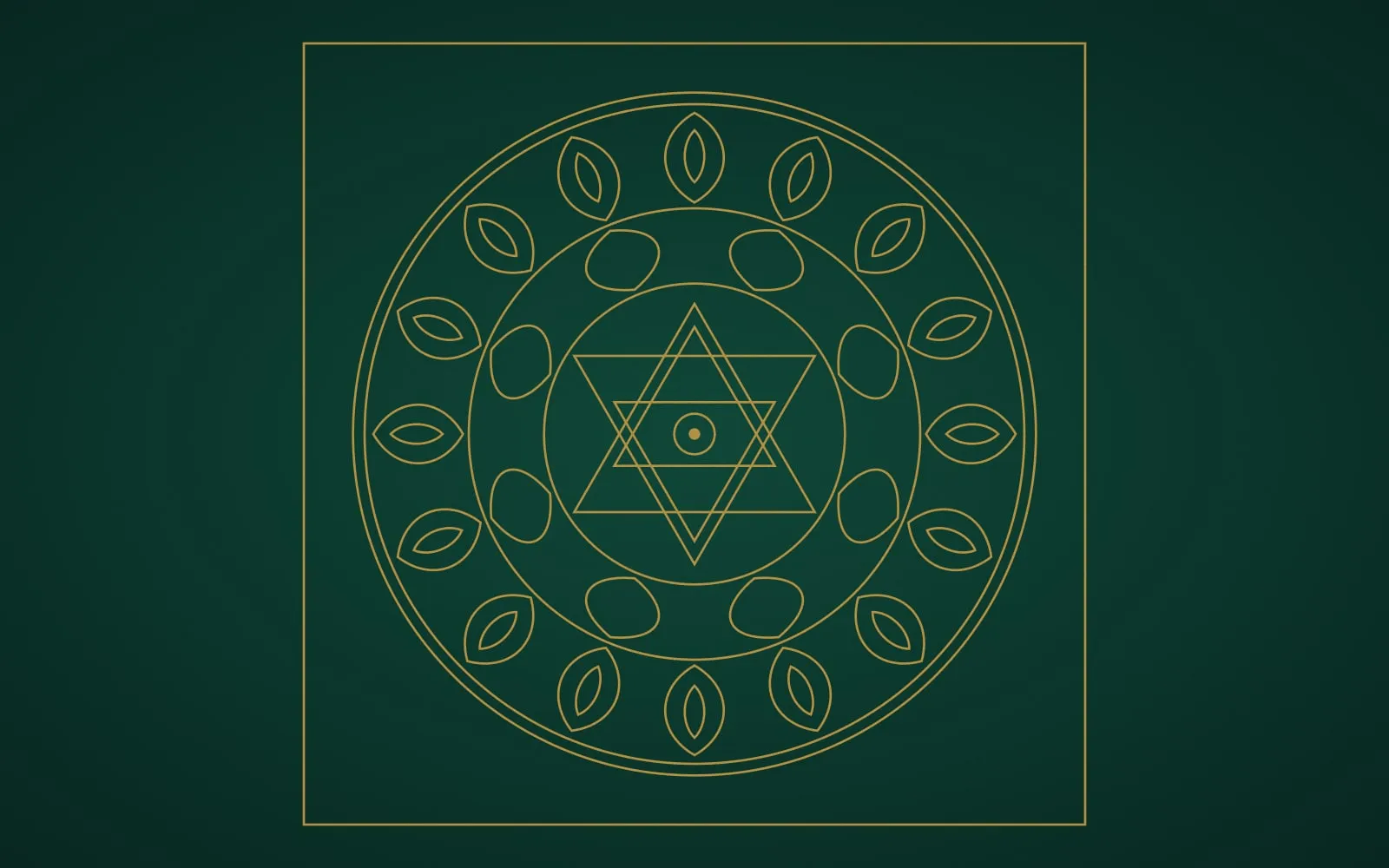
Open the front page of this journal and a yantra draws itself in gold: a square gateway, two rings of lotus petals, interlocking triangles, a single dot at the centre. None of it is an image file. It’s about sixty lines of TypeScript generating SVG paths at build time.
One petal, repeated
Everything starts with a single function that draws one petal pointing straight up — two Bézier curves meeting at a tip:
export function petal(r0: number, r1: number, w: number) {
  const h = r1 - r0;
  return `M0,${-r0} C${w / 2},${-(r0 + h * 0.25)} ${w / 2},${-(r0 + h * 0.75)} 0,${-r1}
          C${-w / 2},${-(r0 + h * 0.75)} ${-w / 2},${-(r0 + h * 0.25)} 0,${-r0}Z`;
}
Rotate it sixteen times around the centre and you have a lotus. Change three numbers and you have a different lotus.
Building the yantra, layer by layer
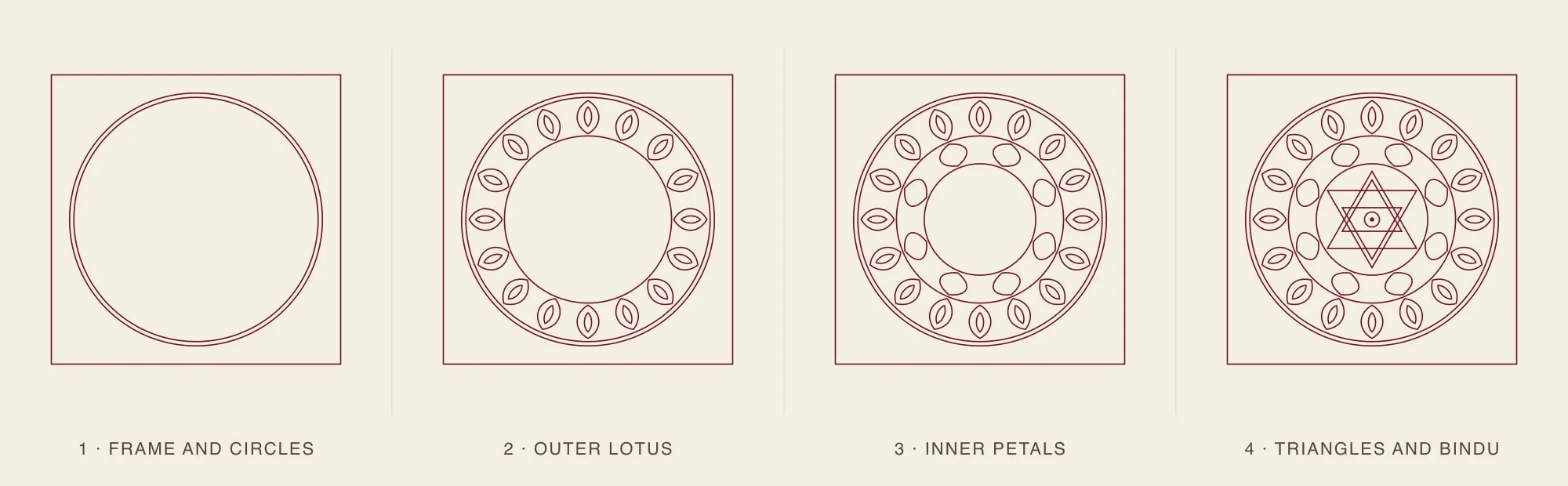
The four layers of the yantra. Each panel adds one ring of geometry.
- Frame and circles — a square gateway (the bhupura) and two concentric circles.
- Outer lotus — sixteen petals, each with a smaller petal inside it.
- Inner petals — eight broader petals, offset by half a step.
- Triangles and bindu — interlocking triangles and the central dot.
Drawing it in
Each path is given pathLength="1", which lets CSS treat every line as exactly one unit long, whatever its real length. Animate stroke-dashoffset from 1 to 0 and the line appears to be drawn by an invisible pen. Stagger the delays and the whole figure blooms from the outside in.
The gilt frame
Pictures on this site sit inside a frame borrowed from Mughal miniatures: a double gold rule with a small lozenge at each corner. It’s four lines of CSS — two borders and four rotated squares — so it scales to any size and recolours itself for dark mode. When a picture first scrolls into view it settles into place and a single band of gold light passes across it, like light catching gold leaf.
Why bother?
Because vector drawings stay sharp at any size, weigh almost nothing, adapt to dark mode with a single colour variable, and can move. A photograph of a yantra would be heavier, blurrier and frozen in place.
That said, a blog still needs photographs sometimes — which is why this post has a cover image and an inline figure. Both are optimised automatically at build time into modern formats and several sizes.
This is a sample post showing how images work. Replace it with your own.